How to Start an NEMT Business in Illinois
Everything it takes to start a NEMT business in Illinois: entity setup, your PT/MC plates from the Illinois Commerce Commission, HFS IMPACT Medicaid enrollment, insurance, driver background checks, dispatch software, and MCO credentialing, laid out in the order you'll actually tackle it.
What NEMT providers in Illinois are working with
about 12.5 million
Residents statewide in Illinois, the pool of potential facility and private-pay referrals your fleet can reach.
Illinois Medicaid (HFS Medical Transportation)
Illinois's Medicaid program. Members eligible for non-emergency transport benefits are routed through it before reaching a broker.
ModivCare, MTM, Access2Care, and Alivi Health
The Medicaid transportation broker(s) active in Illinois that assign trips and set per-mile rates for credentialed providers.
9 Steps to Start an NEMT Business in Illinois
Illinois' real operating authority isn't Medicaid enrollment, it's PT/MC plates from the Illinois Commerce Commission (ICC). Every vehicle transporting patients for compensation needs them before it can legally operate, and that's on top of a passed IDPH vehicle inspection and Medicaid enrollment through the Department of Healthcare and Family Services' (HFS) IMPACT portal. Layer on Illinois' geography, Cook County alone holds nearly 40% of the state's population, and the calculus changes depending on whether you're competing inside Chicagoland or building a presence downstate in Springfield, Peoria, or Rockford.
This guide covers the NEMT business requirements Illinois actually enforces, in the order operators usually work through them: business registration, your ICC PT/MC plates, IDPH inspection, insurance, driver screening, dispatch software, and HFS/MCO enrollment. It's written for someone starting from zero. If a piece of this is already handled, skip ahead to the step you need.

Form your LLC with the Illinois Secretary of State (roughly $150) and get an EIN from the IRS. Pick up any local business license your city or county requires before you move further.
Apply for a Type 2 (Organization) National Provider Identifier at NPPES.hhs.gov. It's free and usually clears in 1 to 4 weeks, and you'll need it for both HFS enrollment and MCO credentialing later on.
File with the ICC for Public Transportation/Motor Carrier plates, required to legally transport medical patients in Illinois. Budget a $200 to $500 filing fee and 4 to 8 weeks for processing, and have proof of insurance and your vehicle information ready, since the ICC won't approve the application without them.
Every NEMT vehicle needs to clear an Illinois Department of Public Health inspection before it can transport a patient. Budget $50 to $100 and 2 to 4 weeks, and schedule this alongside your ICC filing rather than after it, since both gate your ability to operate.
The ICC's statutory minimum is $350,000 combined single limit, but MCOs and facilities effectively require $1,000,000 per occurrence before they'll work with you. Quote to the higher number from the start, since a policy built to the ICC floor will need to be rebuilt before any MCO credentials you.
Illinois requires a valid driver's license, a clean record (no DUIs, no reckless driving in the past 3 years), a fingerprint-based criminal background check through an approved vendor, and drug and alcohol screening for every driver and attendant. Most insurers also want drivers at least 25 years old with three or more years of driving experience, and brokers layer on passenger assistance training and CPR/First Aid.
Get a HIPAA-compliant dispatch platform running before you submit to HFS or any MCO. It's what receives trip assignments, captures GPS-verified pickup and drop-off times, runs your driver mobile app, and keeps the documentation HFS IMPACT claims and MCO audits both expect.
Submit your Medicaid provider enrollment through the HFS IMPACT portal for fee-for-service billing, free and typically 8 to 16 weeks. Separately, apply to Illinois' managed care plans, which contract transportation brokers like ModivCare, MTM, Access2Care, and Alivi Health, at the same time rather than one at a time, since MCO credentialing can run in parallel.
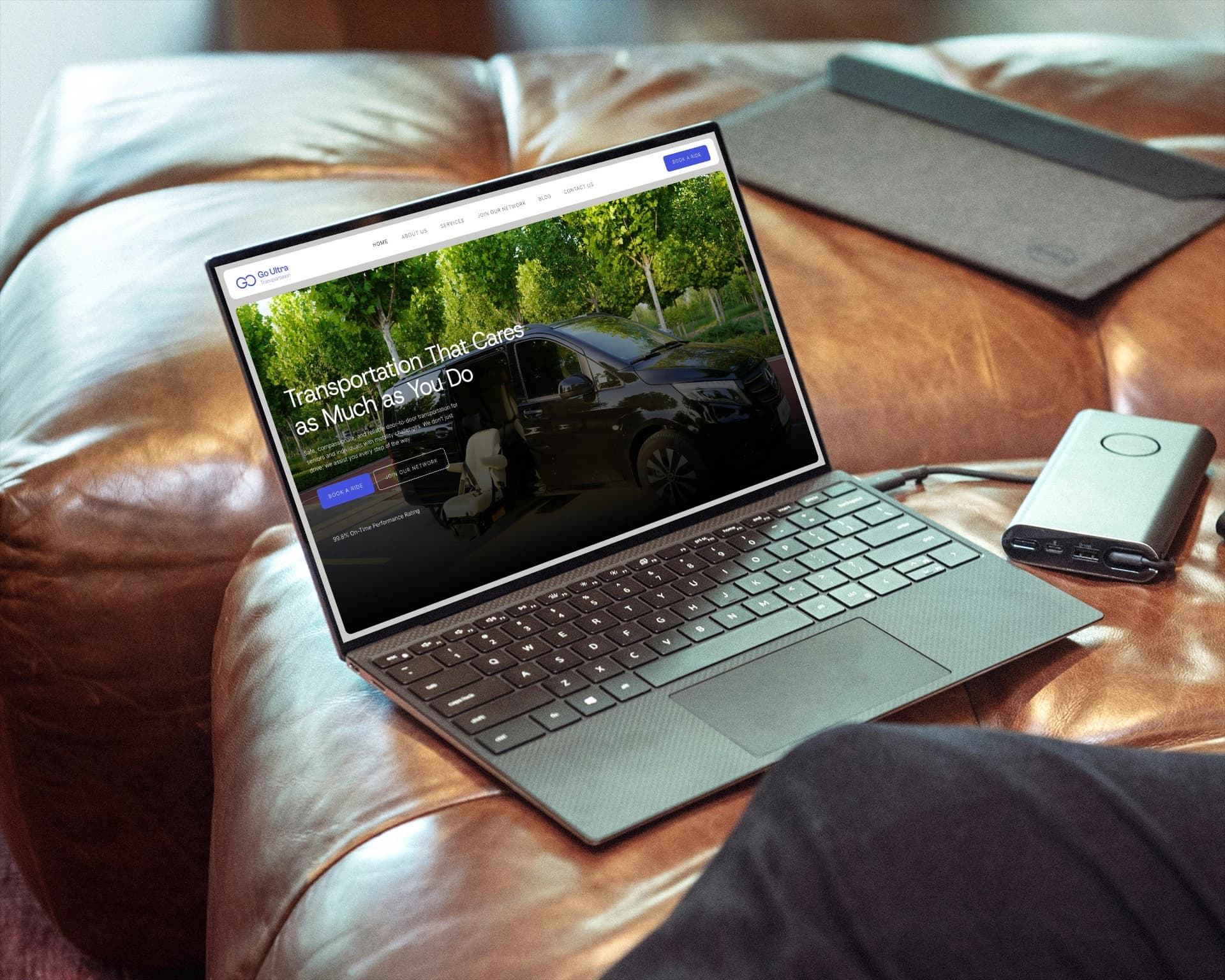
A credentialing-ready website with a service area page for your actual market, Chicago and Cook County or a specific downstate region, speeds up broker approval and starts pulling in direct facility and private-pay bookings from day one.
The Illinois NEMT Market in Numbers
What you're working with before you file your first document.
Illinois residents that Medicaid NEMT benefits could route to your fleet, with Cook County holding nearly 40% of that total.
Most of Illinois' NEMT competition, and most of its opportunity, sits inside one metro.
Typical processing time for Public Transportation/Motor Carrier plates, Illinois' real operating authority.
The ICC's statutory minimum versus what MCOs and facilities effectively require before they'll credential you.
Typical processing time for a complete fee-for-service Medicaid provider application, and it's free.
Business registration through MCO credentialing, when the parallel tracks are run correctly.
Licensing, Vehicles, Software, Brokers & Marketing in Illinois
Most states don't require a standalone operating permit for NEMT vehicles, but Illinois does. Public Transportation/Motor Carrier plates from the Illinois Commerce Commission are required before any vehicle can legally transport a patient for compensation, and the ICC won't approve your application without proof of insurance and complete vehicle information already on file. Budget a $200 to $500 filing fee and 4 to 8 weeks for processing.
Alongside your ICC filing, every vehicle needs to pass an inspection from the Illinois Department of Public Health, a $50 to $100 cost that typically clears in 2 to 4 weeks. Schedule both processes together rather than treating IDPH as an afterthought once your ICC plates are approved, since either one gates whether you can actually operate.
Treat PT/MC plates as Illinois' real equivalent to an NEMT license. Operators who assume Medicaid enrollment alone covers them are usually the ones stuck mid-launch waiting on an ICC filing they didn't start early enough.
Illinois' statutory minimum for NEMT insurance, set by the ICC, is $350,000 combined single limit. Almost no MCO or facility actually credentials at that number, though. The effective requirement across Illinois' managed care plans runs closer to $1,000,000 per occurrence, and quoting to the lower statutory floor just means rebuying coverage once you start MCO credentialing.
Annual premiums vary by vehicle type: ambulatory sedans and SUVs typically run $4,200 to $7,500 per vehicle, wheelchair-accessible vans run $6,800 to $12,000, and stretcher-equipped ambulettes run $10,000 to $18,000. Add workers' compensation once you have employee drivers, generally $3,000 to $8,000 a year depending on payroll.
Get your quote against the $1,000,000 figure from the start. It costs more upfront than insuring to the ICC floor, but it's the number that actually determines whether an MCO will work with you.
Illinois requires fingerprint-based criminal background checks, run through an approved vendor, for every owner, driver, and attendant involved in Medicaid-funded transportation, and results have to clear before that person starts working. A standard name-based check doesn't satisfy this requirement.
Drivers need a clean record with no DUIs and no reckless driving convictions within the past 3 years, plus drug and alcohol screening. Most insurers also expect drivers to be at least 25 with three or more years of driving experience, even though that's not always a hard state requirement, since it affects your premium either way. Add passenger assistance training and current CPR/First Aid certification, which most brokers ask for during credentialing.
A dispatch platform built for NEMT handles the basics everywhere: receiving trip assignments, capturing GPS-verified pickup and drop-off times, and running a driver mobile app. In Illinois, it also needs to keep the documentation HFS IMPACT claims review and MCO audits both expect, since incomplete trip records are a common reason claims get denied or delayed.
Treat it as a monthly cost, not a one-time purchase. Most platforms bill per vehicle or per month, so build it into what you charge per trip from the start rather than treating it as a startup expense you eventually outgrow.
HFS IMPACT handles Illinois' fee-for-service Medicaid enrollment. It's free, and a complete application typically clears in 8 to 16 weeks. That gets you into the state's billing system, but it doesn't automatically connect you to managed care trip volume.
Illinois' Medicaid managed care plans each contract their own transportation broker, commonly ModivCare, MTM, Access2Care, or Alivi Health, and credentialing with each plan runs on its own timeline, generally 8 to 16 weeks, though several can process simultaneously if you apply to all of them at once rather than waiting on one approval before starting the next.
Missing documentation is the most common reason credentialing stalls with either HFS or an MCO. Have your entity documents, NPI, ICC plates, IDPH inspection results, insurance certificates, and driver files ready to submit as a complete package.
Cook County holds nearly 40% of Illinois' entire population, so if you're operating in Chicagoland you're competing for visibility in one of the most concentrated NEMT markets in the Midwest. Downstate, in Springfield, Peoria, or Rockford, competition thins out fast, but so does the online infrastructure most providers never bother to build. Your site needs a service area page for your actual market, not a generic statewide page. We build broker-ready NEMT websites sized to whichever Illinois market you actually serve.
Claim and verify your Google Business Profile the same week you register your business. List it under Non-Emergency Medical Transportation Service, set your service area to the specific counties or Chicago neighborhoods you cover, and start collecting reviews early.
In Chicago and Cook County, expect local SEO rankings to take 90 to 150 days given the density of competition. Downstate, meaningful rankings can show up faster simply because far fewer providers have built a real online presence. Either way, branding and a working website let you capture private-pay bookings while your ICC, IDPH, and HFS applications are still working through the system.

Ready to launch your Illinois NEMT business?
We build broker-ready websites and marketing systems for Illinois NEMT operators from day one, whether you're in Chicago's crowded market or building the default option downstate, so you're pulling in private pay and facility bookings while your ICC and HFS applications are still processing.
3 Mistakes That Slow Down Illinois Operators
The most common, and most avoidable, delays new operators run into.
The statutory minimum is $350,000 combined single limit, but MCOs and facilities effectively require $1,000,000 per occurrence. Operators who quote to the lower number end up rebuying coverage mid-credentialing.
The ICC won't issue PT/MC plates without proof of insurance and vehicle information already on file, and IDPH still has to inspect the vehicle separately. Buying first and sorting out the paperwork after just adds weeks you didn't need to lose.
HFS IMPACT gets you into Illinois' fee-for-service Medicaid billing system, but managed care trip volume runs through separate MCO credentialing with brokers like ModivCare, MTM, Access2Care, or Alivi Health. Skipping that step leaves real volume on the table.
What It Costs and How Long It Takes in Illinois
LLC formation & IL Secretary of State filing
$150
ICC PT/MC plate filing
$200 – $500
IDPH vehicle inspection
$50 – $100
Vehicle (used wheelchair van)
$25,000 – $55,000
Commercial insurance, annual (wheelchair van)
$6,800 – $12,000
Workers' compensation (annual)
$3,000 – $8,000
Driver background check & certification per driver
$300 – $700
NEMT dispatch software (monthly, per vehicle)
$100 – $300 / mo
Website and branding
$999 – $3,000
Business registration, EIN, NPI
1 – 2 weeks
ICC PT/MC plates + IDPH inspection
4 – 8 weeks
Insurance binding (parallel)
2 – 3 weeks
Driver hiring and credentialing (parallel)
3 – 6 weeks
HFS IMPACT enrollment
8 – 16 weeks
MCO/broker credentialing
8 – 16 weeks per plan
Total, start to first trip
Typically 3 – 6 months
Who Should Start an NEMT Business in Illinois?
Illinois' NEMT opportunity looks different depending on where you operate, from Cook County's concentrated competition to downstate markets with far less of it.
Chicago & Cook County Operators
Competing in one of the most concentrated NEMT markets in the Midwest, where nearly 40% of the state's population lives. A fast ICC and MCO credentialing package plus a real local SEO presence matter most here.
Downstate Illinois Operators
Serving Springfield, Peoria, Rockford, or a surrounding county with far less competition and far less built-out online visibility. A provider who builds a real presence here can become the default option quickly.
Growing Multi-County Fleets
Expanding past your first county? Revisit which MCOs and brokers are active in each new region, since managed care plan coverage and broker assignments can both shift as you grow.
Frequently asked questions
How much does it cost to start an NEMT business in Illinois?
Do I need an Illinois NEMT license to start my business?
How long does it take to get ICC PT/MC plates in Illinois?
What are Illinois' real insurance minimums for NEMT vehicles?
How long does HFS IMPACT enrollment take in Illinois?
Which NEMT brokers operate in Illinois?
What background check do Illinois NEMT drivers need?
Can I start an NEMT business in Illinois with one vehicle?
What NEMT dispatch software do I need in Illinois?
NEMT Marketing Resources
Deep dives into the strategies that help medical transport providers scale.
Article
Learn the exact strategy we use to help NEMT providers dominate local search and stop relying on broker volume.
Article
Digital credentialing is getting harder. Here is the checklist you need to pass MTM and Modivcare verification.
Article
We break down why shifting just 20% of your volume to private pay can double your net profit and improve your margins.