Author

Published
July 1, 2026
Reading time
12 min read
Content
What the 2026 Rate and Cost Survey Found
Why Your Costs Keep Rising While Rates Stay Flat
The Rural Provider Exodus Nobody Is Talking About
Why No-Shows and EVV Denials Are Quietly Eating Your Margin
Broker Rates vs Private Pay: Do the Math Before You Decide
How to Find Out If Your Rates Are Actually Profitable
Fuel Surcharges Most Providers Forget to Charge
Five Steps to Protect Your Margin This Quarter
Frequently Asked Questions
Why are NEMT reimbursement rates so low in 2026?
How do I know if a broker contract is actually profitable?
Can I charge a fuel surcharge on Medicaid broker trips?
Is private pay actually more profitable than broker trips?
How much does EVV compliance cost per trip?
What percentage of NEMT trips are no-shows?
Should rural NEMT providers worry about the 2026 rate environment?
Blog post categories
Need a Digital Partner?
Access a dedicated team of NEMT designers and developers. We handle your tech, branding, and growth so you can focus on your mission.
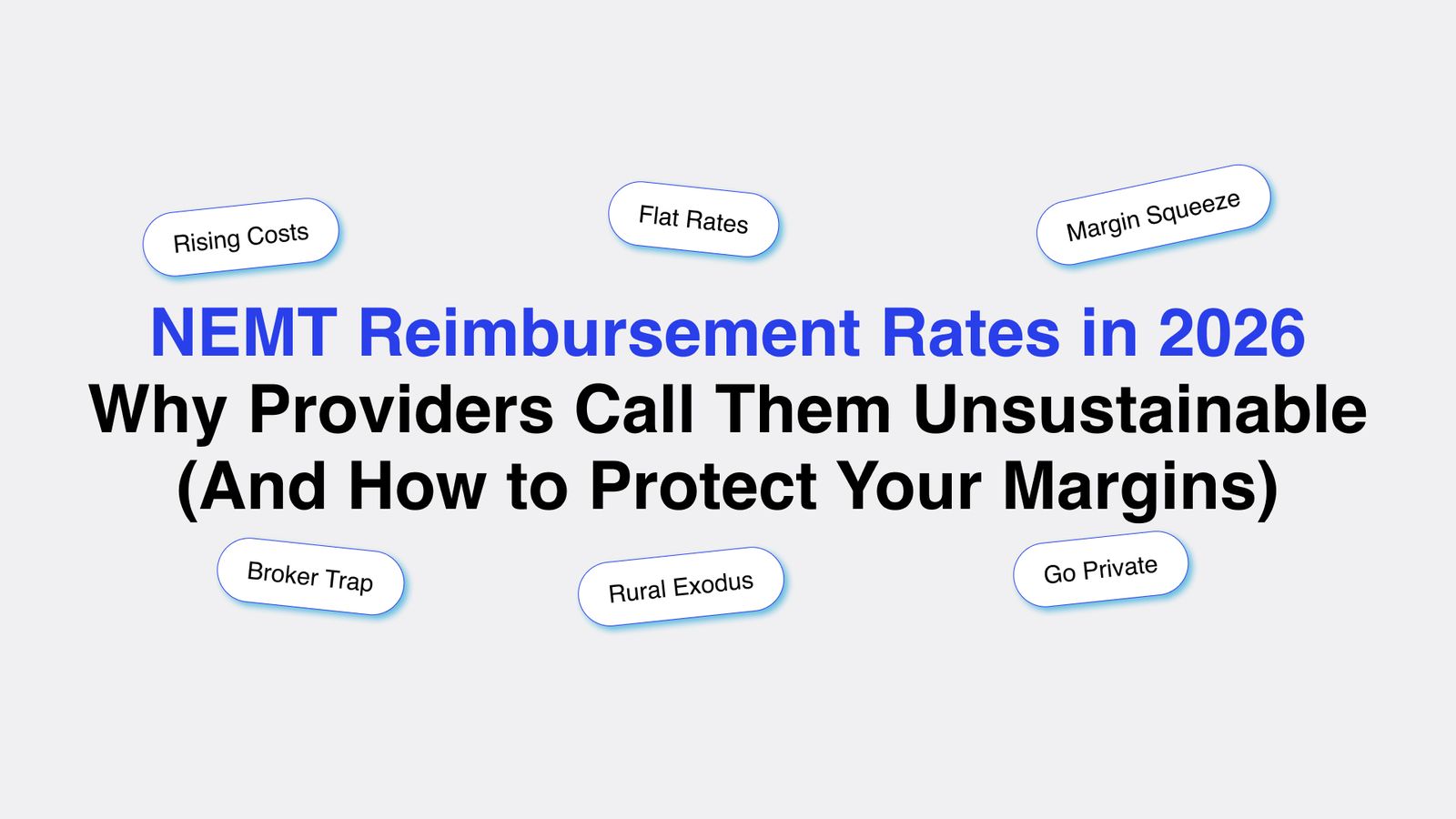
See How It WorksNEMT Reimbursement Rates in 2026: Why Providers Call Them Unsustainable (And How to Protect Your Margins)
NEMT reimbursement rates have not kept pace with your costs. Fuel, insurance, driver wages, dispatch software, and EVV compliance keep climbing every year, but broker rates barely move. A 2026 NEMTAC Rate and Cost Survey found that 65 to 70 percent of providers call their current rates barely sustainable, and about 60 percent expect rural providers to leave the industry if the pattern continues.
If your business runs on broker trips alone, this is not a future problem. It shows up in your bank account this month. This guide breaks down why NEMT reimbursement rates have fallen behind, what the gap actually costs you per trip, and the steps you can take right now to protect your margin.
What the 2026 Rate and Cost Survey Found
The NEMTAC 2026 Rate and Cost Survey put numbers behind what most operators already felt. Between 65 and 70 percent of respondents said their current reimbursement rates barely cover operating costs. Roughly 60 percent expect rural providers to exit the market if rates stay where they are.
Twenty-six states raised NEMT rates in fiscal year 2024, and more than 20 states proposed additional increases for fiscal years 2025 and 2026. That sounds like progress until you look at the timeline. Most of those increases were built on 2021 and 2022 cost assumptions. Fuel, insurance, and labor costs have moved well past that baseline since then, so even providers who received a rate increase are often still behind where they need to be to break even on broker trips.
Payer demand is shifting too. Some Medicare Advantage plans are scaling back transportation benefits, and proposed changes to Medicaid funding could remove a meaningful share of currently eligible members over the next decade. If you have built your business around steady demand from every payer source, plan for a smaller and more competitive pool of trips going forward, not a larger one.
If you set your pricing or accepted broker contracts based on your costs from three or four years ago, you are very likely losing money on a share of your trips without realizing it.
Why Your Costs Keep Rising While Rates Stay Flat
Four cost categories explain most of the squeeze.
Insurance. NEMT insurance rates in 2026 are running 12 to 15 percent higher than 2024 levels. Carrier appetite is shrinking, so fewer insurers are willing to write NEMT policies, and the ones that stay are pricing for more risk. Average bodily injury claim settlements rose about 18 percent between 2022 and 2025, driven by medical inflation and more attorney involvement in transport-related injury claims. Annual insurance costs now run $4,000 to $12,000 per vehicle depending on vehicle type.
Fuel. Fuel prices swing constantly, but very few broker contracts include an automatic fuel adjustment. If your rate was set when fuel cost less, you are absorbing every dollar of the increase yourself, trip after trip, with no way to recover it unless you go back and renegotiate.
Labor. Driver wages have risen across nearly every state as operators compete with rideshare and delivery work for the same pool of workers. Retention costs money too. Every driver you lose and replace costs you in training time, background checks, and lost trips during the gap between hires.
Technology and EVV compliance. Electronic Visit Verification is now required in most states, and per-trip software costs typically run $0.65 to $1.20, with some platforms reaching $2.10 depending on features. That is a real cost per trip that did not exist a few years ago, and it rarely shows up in anyone's original rate calculation.
| Cost category | Typical 2026 cost | What's driving it |
|---|---|---|
| Insurance (per vehicle, annual) | $4,000 to $12,000 | Rates up 12 to 15 percent since 2024; claim settlements up about 18 percent since 2022 |
| Wheelchair van insurance | $565 to $1,000 per month | Fewer carriers writing NEMT policies |
| Stretcher van insurance | $835 to $1,500 per month | Highest risk vehicle class |
| EVV and dispatch software | $0.65 to $1.20 per trip | New compliance layer most legacy rates never priced in |
| No-shows and cancellations | 12 to 20 percent of scheduled trips | Fewer billable trips per shift, same fixed costs |
The Rural Provider Exodus Nobody Is Talking About
Rural NEMT providers face the tightest squeeze of all. They cover longer distances per trip, see fewer trips per day, and have less local competition to push volume. When 60 percent of surveyed operators expect rural providers to leave the industry, that is not a hypothetical. It is a warning about where the market is headed.
If you operate in a rural or semi-rural service area, the mileage math matters more than it does in a city. A trip that pays $60 in a metro area might cover forty minutes of driving for you and only twenty minutes for a city-based competitor. Your fuel, wear on the vehicle, and driver hours all cost more per completed trip.
The providers who survive this stretch are the ones who track their real cost per mile and per trip, not their total monthly revenue alone. If you have not run that number recently, start there before you make any other change to your business.
Why No-Shows and EVV Denials Are Quietly Eating Your Margin
No-shows and late cancellations run 12 to 20 percent industry-wide. Every one of those trips still costs you a driver, a vehicle, and time on the schedule, but it pays you nothing. If you are already running on thin broker margins, a 15 percent no-show rate can be the difference between a profitable month and a losing one.
EVV compliance adds a second layer. States with EVV mandates see claim denial rates around 18 percent industry-wide when integration is weak, compared to 5 to 8 percent for providers with solid EVV systems in place. That gap is revenue you are either collecting or leaving on the table, depending on how well your dispatch and billing systems talk to each other.
Some operators are using predictive scheduling tools to cut no-shows by up to 30 percent and reduce manual scheduling time by 40 percent within the first three months of use. You do not need the most expensive platform on the market. You need one that reliably logs pickup and drop-off data the way your state requires and flags no-show patterns before they become a habit with a specific rider or facility.

Ready to win more private pay and facility clients?
Talk to our team about a website and local SEO built specifically for NEMT providers, so you spend less time chasing broker scraps and more time booking higher-margin trips.
Broker Rates vs Private Pay: Do the Math Before You Decide
Broker trips give you volume and predictability, but they rarely give you margin. Private pay clients and direct facility contracts almost always pay more per trip, and you set the rate instead of accepting whatever the broker offers.
The tradeoff is that private pay and facility work take more effort to win. You need a website that ranks locally, a way for families and discharge planners to book you directly, and a reputation that holds up when someone searches your name before calling. That is a real investment, but it changes your revenue mix instead of adding more low-margin trips to your schedule.
Before you decide how much of your business should run on broker trips versus private pay, run the actual numbers side by side. The broker vs private pay comparison tool on our site walks through cost per trip, effective hourly revenue, and what a shift in your mix would mean for your monthly income. Most operators are surprised by how much a modest increase in private pay trips changes their bottom line.
How to Find Out If Your Rates Are Actually Profitable
Most NEMT operators price by habit. They accept whatever the broker offers or copy a number a competitor mentioned once, and they never go back and check it against their real costs. That is how a rate that worked in 2022 becomes a loss in 2026 without you noticing.
Start with your true cost per trip: fuel, insurance, driver pay, vehicle maintenance, software, and a share of your overhead divided across your monthly trip count. Compare that number against what each payer actually pays you, broker by broker and contract by contract. You will likely find that some contracts are profitable and others are barely breaking even or losing money once mileage and wait time are factored in.
Our NEMT profit calculator walks you through this comparison using your own numbers. Once you know your real cost per trip, our NEMT rate card generator helps you build a rate sheet you can bring into contract negotiations or use when quoting private pay clients directly. Long wait times at facilities cost you money even when you are not being paid for that time, and the wait time cost estimator puts a real number on it.
Fuel Surcharges Most Providers Forget to Charge
Fuel is one of the few costs you can adjust for without renegotiating an entire contract. Many providers set a flat rate years ago and never added a fuel surcharge clause, even as fuel costs moved well past that original baseline.
If your contracts allow for a surcharge and you are not charging one, you are giving away margin for no reason. If your contracts do not allow for one, that is worth raising at your next renewal, especially with current rate data to back up the request.
Use our fuel surcharge calculator to see exactly what a fair surcharge looks like based on current fuel prices and your typical trip mileage. Bring that number into your next broker conversation instead of guessing.
A provider running 15 wheelchair van trips a day with an average 18 mile round trip can lose several hundred dollars a month in fuel costs alone if the rate has not been adjusted since fuel prices last spiked. Multiply that across a fleet of five or six vehicles and the total adds up quickly.
Five Steps to Protect Your Margin This Quarter
- Calculate your real cost per trip using your actual fuel, insurance, labor, and software numbers, not last year's estimate.
- Compare every broker contract against that number and flag any that are unprofitable once mileage and wait time are included.
- Add or update fuel surcharge language in contracts that allow it, and raise the topic at your next broker renewal if they do not.
- Set a target for private pay and facility trips as a share of your total volume. Even a modest 15 to 20 percent shift changes your overall margin.
- Fix the parts of your online presence that cost you private pay clients. A website that does not rank locally, no online booking, and no reviews all push potential clients toward a competitor who looks more established.
That last point is where a lot of operators get stuck. Winning higher-margin private pay and facility contracts depends on being findable and credible online. Our team handles NEMT web development, local SEO for NEMT providers, and digital marketing built specifically for medical transportation, so you are not competing for private pay clients with a website built for a different industry. Visit our NEMT services page to see the full picture, check how the process works, and review pricing when you are ready to talk.
Frequently Asked Questions
Why are NEMT reimbursement rates so low in 2026?
Most state and broker rate structures were built on 2021 and 2022 cost assumptions. Fuel, insurance, and labor costs have risen faster than reimbursement rates in most states, even where rate increases were approved for fiscal year 2024 or 2025.
How do I know if a broker contract is actually profitable?
Calculate your true cost per trip, including mileage, wait time, insurance, and driver pay, then compare it against what the broker pays per completed trip. Our NEMT profit calculator runs this comparison using your own numbers so you are not guessing.
Can I charge a fuel surcharge on Medicaid broker trips?
It depends on your contract. Some broker agreements allow a fuel surcharge clause and others do not. Check your current contract language, and if it does not allow one, raise it at your next renewal using current fuel cost data.
Is private pay actually more profitable than broker trips?
In most cases, yes. Private pay and direct facility contracts typically pay more per trip and let you set your own rate, though they require marketing and a stronger online presence to win consistently.
How much does EVV compliance cost per trip?
Per-trip EVV and dispatch software costs typically run $0.65 to $1.20, with some platforms reaching $2.10 depending on features. Weak EVV integration also increases claim denial rates, which costs more than the software fee itself.
What percentage of NEMT trips are no-shows?
Industry-wide, no-show and late cancellation rates run 12 to 20 percent of scheduled trips. Predictive scheduling tools can reduce that by up to 30 percent when used consistently.
Should rural NEMT providers worry about the 2026 rate environment?
Yes. Rural providers face longer trip distances, fewer trips per day, and less competition to push volume, which makes flat reimbursement rates hit harder. Tracking real cost per mile is essential for rural operators right now.
NEMT reimbursement rates are not going to fix themselves, and waiting for the next state rate increase is not a plan. The providers who protect their margin in 2026 are the ones who know their real cost per trip, charge for what they are owed, and build a revenue mix that does not depend entirely on rates set by someone else.
Start with your numbers. Run your cost per trip through the profit calculator, check your fuel surcharge, and see what a shift toward private pay could mean for your business. If you want help building the website and local SEO that brings those higher-margin clients to you, contact our team and we will walk you through it.
Related Blogposts
Continue reading more insights from our medical marketing experts.
NEMT Business Strategy
Medicaid brokers control your rates and your risk. Here's how NEMT owners are building a private pay revenue stream in 2026 to protect margins.
NEMT Business Strategy
Diesel is up nearly a dollar a gallon year over year, and most NEMT contracts have no fuel clause. Here's the exact math and language to build one that gets approved.
NEMT Business Strategy
NEMT commercial auto insurance costs $5,500 to $16,000+ per vehicle in 2026. See exact rates by vehicle type, broker coverage minimums, and how to cut your premium.
NEMT Business Strategy
How to get NEMT contracts from Medicaid brokers, healthcare facilities, and private-pay clients. Step-by-step guide with credentialing, outreach, and follow-up strategies.
NEMT Business Strategy
Learn exactly what to put on your NEMT homepage to convert brokers, facility coordinators, and patients into clients, section by section.
NEMT Business Strategy
Your NEMT website is the first thing clients and facility staff check before they call you. A weak site loses bookings every day. This post covers the exact pages, forms, and features your site needs to rank on Google, build trust with visitors, and turn that traffic into booked trips.
Marketing & Design Newsletter
Subscribe to our newsletter and get cutting-edge marketing strategies, design inspiration, and exclusive tips delivered straight to your inbox.