Author

Published
August 11, 2026
Reading time
9 min read
Content
Blog post categories
Need a Digital Partner?
Access a dedicated team of NEMT designers and developers. We handle your tech, branding, and growth so you can focus on your mission.
See How It WorksHow to Start an NEMT Business in Illinois: Complete 2026 Guide
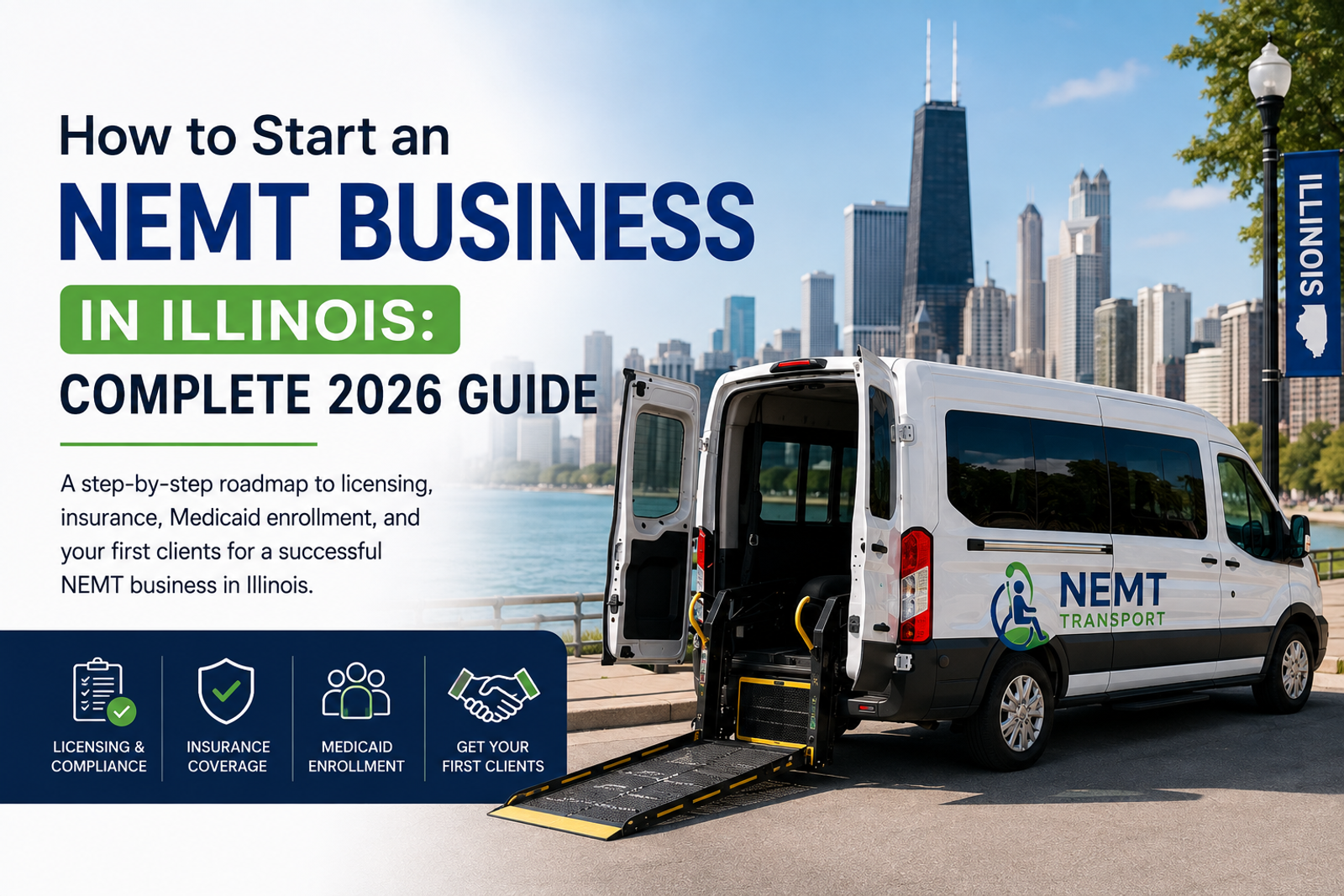
A step-by-step roadmap to licensing, insurance, Medicaid enrollment, and your first clients — built for founders launching a non-emergency medical transportation company anywhere from Chicago to downstate Illinois.
Why Illinois Is a Strong Market for a New NEMT Business
Illinois combines a large Medicaid population, an aging resident base, and a payer system that lets providers bill the state directly instead of routing every trip through a broker. That fee-for-service option, layered on top of managed care contracts with plans like Meridian, Molina, and IlliniCare, gives a new operator more than one way to get paid in year one.
The opportunity isn't evenly spread, though. Chicago and the collar counties have the highest trip volume but also the most established competitors. Downstate and rural counties have thinner competition and real transportation gaps — especially around dialysis centers and critical-access hospitals — but lower population density means longer deadhead miles between trips. Deciding which of these two environments you're building for should shape almost every decision below, from your first vehicle to your first sales call.
Step 1: Research Your Local Market Before You Spend a Dollar
Start by mapping the facilities that generate recurring NEMT demand in the area you plan to serve: dialysis clinics, oncology centers, skilled nursing and rehab facilities, adult day care centers, and hospital discharge departments. Illinois has well over a hundred adult day care centers statewide plus dozens of dialysis providers concentrated around population centers, and each one is a potential referral source once you're operating.
Then look at who's already serving them. Provider directories from the Illinois Public Health Association and Medicaid MCO provider lists will show you which companies operate in your target ZIP codes, whether they run wheelchair vans, ambulatory sedans, or stretcher service, and where coverage thins out. A market with three ambulatory-only competitors and no stretcher provider is a very different opportunity than a market that's already saturated at every service level.
Don't treat existing providers purely as competition. Many NEMT founders get their first referrals from a competitor who's over capacity and needs an overflow partner — a phone call is worth more than a spreadsheet here.
Step 2: Build a Business Plan That Answers Four Questions
Your plan doesn't need to be long, but it needs to be specific about: which services you'll offer (ambulatory, wheelchair, stretcher, or a combination), what geographic radius you'll cover, which payer mix you'll pursue, and how much cash you need to survive six months with little or no revenue.
Medicaid enrollment in Illinois realistically takes two to four months, so private pay and facility contracts are what keep the lights on early. If you're weighing how to split your early focus, MedFlow's broker vs. private pay comparison tool is a quick way to see how the two revenue streams stack up before you commit marketing dollars to either one. Most operators that succeed pursue both tracks from day one rather than waiting for Medicaid approval to start booking rides.
- Define service types and whether you'll launch with one or more
- Set a starting service radius — most single-vehicle operators start with 25–30 miles
- Model a startup budget and a 3–6 month operating reserve separately
- Identify 2–3 recurring patient types (dialysis, chemo, dialysis-adjacent nursing home routes) that can anchor your first vehicle's schedule
Step 3: Register Your Business Entity
Most new NEMT operators register as an LLC with the Illinois Secretary of State, which limits personal liability while keeping tax filing simple; filing runs around $150. After formation, apply for a free federal EIN through the IRS — you'll need it for your business bank account, insurance applications, and later for Medicaid enrollment.
From there, register with the Illinois Department of Revenue for state tax accounts, and, once you plan to hire drivers, with the Illinois Department of Employment Security for unemployment insurance. Open a dedicated business bank account before your first vehicle purchase; commingling personal and business funds is one of the most common reasons new operators run into trouble during a Medicaid audit.
Step 4: Get Licensed to Operate
Three approvals stand between you and legally transporting a patient in Illinois:
- PT/MC plates from the Illinois Commerce Commission — required for every NEMT vehicle, with proof of insurance and a filing fee; expect roughly 4–8 weeks.
- An organizational (Type 2) NPI number through CMS's NPPES system, needed for Medicaid billing; typically 1–4 weeks, so apply as early as possible.
- An IDPH vehicle inspection confirming safety equipment and, for ADA vehicles, a compliant wheelchair securement system.
If you plan to serve Medicaid recipients specifically, you'll separately need certification from the Illinois Department of Healthcare and Family Services (HFS) — the agency also administers the IMPACT enrollment portal covered in Step 7.
Step 5: Secure NEMT-Specific Insurance
Standard commercial auto insurance won't cover you here. Because you're transporting medically vulnerable passengers, NEMT insurance typically costs more than a standard commercial policy of the same size. The Illinois Commerce Commission's statutory minimum is $350,000 combined single limit, but in practice most MCOs and healthcare facility contracts require $1 million per occurrence — which functions as the real floor if you intend to bill Medicaid or contract with hospitals.
Budget for general liability, professional liability, and — once you have employees — workers' compensation, in addition to commercial auto coverage. Working with a broker who specializes in medical transportation (rather than general commercial fleets) usually gets better pricing and fewer coverage gaps at claim time.
Step 6: Choose Your First Vehicle
Vehicle choice should follow your service plan, not the other way around. Ambulatory-only operators typically start with a minivan — a Toyota Sienna, Honda Odyssey, or Chrysler Pacifica — for its low operating cost and 3–4 passenger capacity. Wheelchair service requires an ADA-compliant conversion van with a ramp or lift and Q-straint tie-downs; used units with a trusted mechanic's inspection can be a reasonable way to control first-vehicle cost.
Stretcher ambulettes generate the highest revenue per trip but carry the steepest acquisition cost, and most new operators are better served waiting until they have a confirmed facility partnership before adding one. One vehicle, run well, is a stronger foundation than three vehicles running under capacity.
Step 7: Enroll as an Illinois Medicaid Transportation Provider
Illinois pays for NEMT through two channels, and most providers eventually need both. Fee-for-service members are billed directly to HFS through the IMPACT provider portal. Managed care members — the majority of Illinois Medicaid enrollees — are billed to their individual plan, so you'll also need separate credentialing with each MCO you intend to work with, commonly Meridian, Molina, and IlliniCare.
Start your IMPACT application as soon as you have your NPI, insurance certificates, and a passed vehicle inspection in hand; enrollment commonly takes two to four months. Apply to your target MCOs in parallel rather than sequentially — their credentialing timelines run independently, and there's no advantage to waiting.
Step 8: Hire and Train Drivers the Right Way
Your driver is the entire customer experience for most trips, and a single bad interaction can end a facility relationship that took months to build. At minimum, Illinois NEMT drivers need a clean driving record, a passed background check, drug and alcohol screening clearance, passenger assistance training, and current CPR/First Aid certification. Many insurers also require drivers to be at least 25 with several years of driving history.
Structured training — pre-trip inspections, wheelchair securement, HIPAA basics, and emergency procedures — should be documented with signed acknowledgments from day one; both your insurer and any Medicaid auditor will eventually ask to see it. MedFlow's NEMT HIPAA compliance checklist is a useful starting point for making sure your intake forms and driver protocols hold up under review.
Step 9: Set Up Dispatch Before You Need It
A single-vehicle operation running under 15 trips a day can get by on a shared calendar, a trip-log spreadsheet, and a dedicated booking line. As volume grows, dedicated NEMT dispatch platforms add scheduling, GPS tracking, and billing integration in one system. GPS tracking specifically earns its cost quickly — it's the record that proves a trip happened when a Medicaid claim gets questioned.
Step 10: Land Your First Clients
Direct outreach beats digital marketing in the first 90 days. Hospital discharge planners, dialysis center social workers, and skilled nursing administrators arrange rides constantly and are actively looking for providers who answer the phone and show up on time. A short in-person visit with a one-page capability sheet — services offered, coverage area, insurance proof, vehicle photos — tends to outperform a cold email.
For private-pay demand, a complete Google Business Profile paired with a fast, mobile-optimized website is the highest-leverage marketing move available to a brand-new operator, since most private-pay families search and book from their phone before they ever call. This is where NEMT-specific SEO and a conversion-ready NEMT website earn their keep — showing up first in local search matters far less if the site that shows up doesn't convert. Standing dialysis orders remain the best long-term anchor for a schedule — a single patient on a three-times-weekly routine fills a meaningful share of one vehicle's capacity on its own.
What It Actually Costs to Launch
| Item | Typical Range |
|---|---|
| LLC formation (IL Secretary of State) | ~$150 |
| PT/MC plates (ICC) | $200–$500 |
| IDPH vehicle inspection | $50–$100 |
| Ambulatory vehicle (minivan) | $25,000–$45,000 |
| Wheelchair-accessible van | $25,000–$85,000 |
| Annual insurance, per ambulatory vehicle | roughly double a standard commercial policy |
| 3–6 month operating reserve | $20,000–$40,000 |
| Total to launch (ambulatory-only) | $30,000–$60,000 |
| Total to launch (with wheelchair service) | $60,000–$85,000+ |
Figures are directional and will vary by insurer, county, and vehicle condition — treat them as a planning range, not a quote. For a gut-check against your own numbers, MedFlow's NEMT profit calculator is a fast way to stress-test a launch budget before you commit to it.
Realistic Timeline From Application to First Ride
| Step | Typical Timeline |
|---|---|
| Entity formation + EIN | 1–2 weeks |
| Insurance binding | 2–4 weeks |
| PT/MC plate approval | 4–8 weeks |
| NPI application | 1–4 weeks |
| IDPH inspection | 2–4 weeks |
| HFS IMPACT Medicaid enrollment | 8–16 weeks |
| MCO credentialing (per plan, can run in parallel) | 8–16 weeks |
Private-pay and facility-contract trips can start well before Medicaid enrollment finishes — most operators are booking rides within 4–8 weeks even while the IMPACT application is still processing.
Where to Go From Here
The regulatory steps above are the same for every operator, but the sequencing that gets you to your first billable ride fastest depends on your market, your starting capital, and whether Medicaid or private pay is your priority revenue stream. Mapping that sequence against your specific service area is the next step before you file anything — and once licensing is underway, the marketing groundwork can start in parallel. See how MedFlow approaches this for NEMT providers and explore our full range of NEMT marketing services to see what pairs well with your launch timeline.
Frequently asked questions
How much does it cost to start an NEMT business in Illinois?
Do I need a special license to operate NEMT in Illinois?
Can I start with just one vehicle?
How long before I can bill Medicaid?
Is NEMT profitable in Illinois?
Related Blogposts
Continue reading more insights from our medical marketing experts.
Marketing & Design Newsletter
Subscribe to our newsletter and get cutting-edge marketing strategies, design inspiration, and exclusive tips delivered straight to your inbox.