Author

Published
August 9, 2026
Reading time
9 min read
Content
Why South Carolina is a strong market for medical transportation
What kind of medical transportation you can start
Step 1: Register and license your business
Step 2: Meet South Carolina's driver and provider requirements
Step 3: Get NEMT insurance
Step 4: Buy and equip your vehicles
Step 5: Contract with ModivCare to serve Medicaid riders
Step 6: Add private-pay and facility contracts
How much it costs to start
Step 7: Get your first riders
Blog post categories
Need a Digital Partner?
Access a dedicated team of NEMT designers and developers. We handle your tech, branding, and growth so you can focus on your mission.
See How It WorksHow to Start a Medical Transportation Business in South Carolina (2026 Step-by-Step Guide)
South Carolina adds more seniors every year, and rural counties still lack enough rides to dialysis, wound care, and follow-up visits. That gap is your opening. If you want to know how to start a medical transportation business in South Carolina, this guide walks you through the real path, from registering your company to getting approved to carry Medicaid riders.
Most guides online skip the one step that matters most in this state. You do not bill South Carolina Medicaid directly for most rides. You contract with the state's transportation broker. Miss that, and you can spend months buying vans with no way to get paid. Get it right, and you can build steady monthly revenue serving people who need you.
Here is the full process, the current requirements, the costs to expect, and how to get your first riders.
Why South Carolina is a strong market for medical transportation
Demand here is not a trend. It is demographic. South Carolina's population is aging, and older adults take more trips to more appointments than any other group. Many of them cannot drive. Many live in rural counties where there is no bus and no ride-share coverage.
Non-emergency medical transportation, or NEMT, fills that gap. You carry people who are not in an emergency but still need safe, reliable transport to care. Think dialysis three times a week, chemotherapy, physical therapy, mental health visits, and hospital discharges.
Your riders come from three sources:
- Medicaid members, arranged through the state broker
- Private-pay clients and their families
- Facility contracts with nursing homes, dialysis centers, and adult day health programs
Medicaid gives you volume. Private pay and facility contracts give you margin. The operators who last build all three.
What kind of medical transportation you can start
NEMT is not an ambulance service. Ambulances handle emergencies and need a different license, crew, and equipment. NEMT covers scheduled, non-emergency trips. That is the lane you want to start in.
Inside NEMT, you choose your service level based on your vehicles and training:
- Ambulatory: riders who can walk and sit in a standard seat
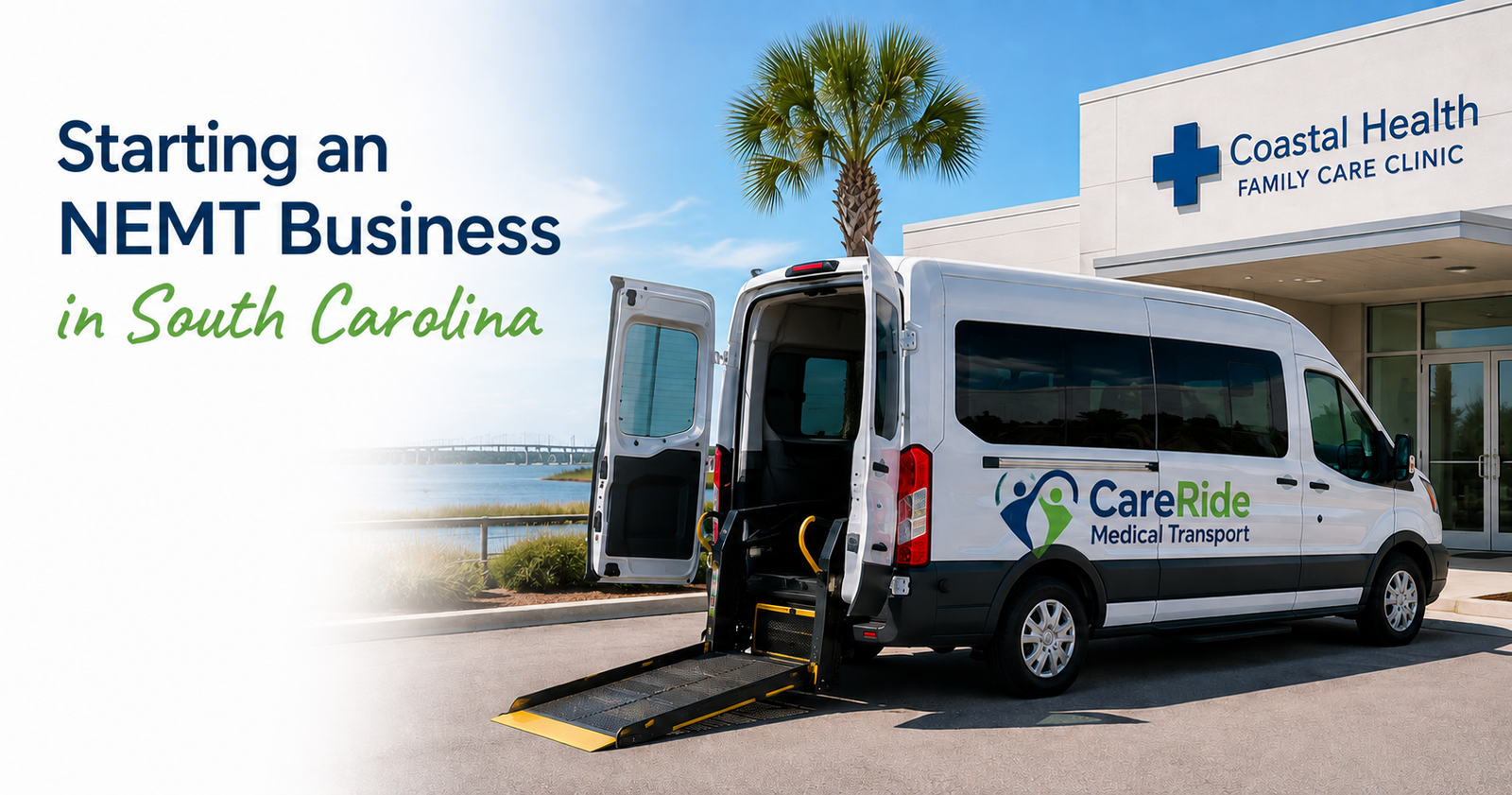
- Wheelchair: riders who stay in their wheelchair, loaded by a lift or ramp
- Stretcher: riders who must lie down, using a secured stretcher
Ambulatory is the cheapest to enter. Wheelchair service costs more to equip but pays more per trip and has less competition. Many new operators start ambulatory, then add a wheelchair van once cash flow is steady.
Step 1: Register and license your business
Set up a real legal entity before you spend a dollar on vehicles. Most NEMT owners form an LLC. It separates your personal assets from the business and looks credible to brokers and facilities.
Here is the order that works:
- Register your LLC with the South Carolina Secretary of State.
- Get a federal EIN from the IRS. It is free and takes minutes.
- Open a business bank account under the LLC.
- Apply for a local business license from your city or county.
Do not skip the local license. Cities like Columbia, Charleston, and Greenville each have their own rules, and brokers and facilities will ask for proof you are legal to operate in your area.
Step 2: Meet South Carolina's driver and provider requirements
South Carolina updated its NEMT rules to match federal standards under the Centers for Medicare and Medicaid Services. Every provider and every driver must clear a check confirming they are not excluded from federal health care programs. If you or a driver appears on that exclusion list, you cannot serve Medicaid riders.
Beyond that, plan for these driver standards. Exact rules can vary by broker, so confirm before you hire:
- Age 21 or older, and many brokers require 25 or older
- Valid South Carolina driver's license in good standing
- Clean criminal background check
- Motor vehicle record review
- Pre-employment drug screen
- CPR and First Aid certification
- Defensive driving or passenger assistance training
Keep a file for each driver with every document. Brokers and auditors will ask to see them, and missing paperwork is one of the fastest ways to lose your standing.
For provider questions, the SCDHHS Provider Service Center is (888) 289-0709.
Step 3: Get NEMT insurance
Insurance is not optional and it is not cheap. It is also what protects your business the day something goes wrong. Work with an agent who writes NEMT policies, not a general auto agent who does not understand medical transport.
South Carolina sets minimum liability limits, and brokers usually require more. Typical minimums look like this:
- General liability: often around $100,000
- Automobile liability: commonly $25,000 per person, $50,000 per accident, and $25,000 property damage
Most brokers and facilities want commercial auto coverage far above the state floor, often up to $1 million combined single limit. Add workers' compensation once you hire drivers. Get quotes from more than one carrier, because NEMT rates swing widely.
Insurance is your single largest fixed cost in year one. Budget for it before you buy a vehicle, not after.
Step 4: Buy and equip your vehicles
Match your vehicle to the service level you chose in Step 2. You do not need a fleet to start. Many operators launch with one reliable van and grow from there.
Common starting vehicles:
- Ambulatory: a clean minivan or sedan with room and easy entry
- Wheelchair: a van with a lift or ramp, tie-downs, and ADA-compliant access
Whatever you buy, register and inspect it through the South Carolina DMV, and keep a maintenance log. Brokers want vehicles that are safe, clean, and documented. A rider who cannot board your van is a trip you cannot bill.
If you can only afford one van, buy a wheelchair-accessible model. It serves both ambulatory and wheelchair riders and opens more contracts.
Step 5: Contract with ModivCare to serve Medicaid riders
This is the step the other guides gloss over, and it is the one that determines whether you get paid.
South Carolina Healthy Connections Medicaid does not schedule and pay individual NEMT providers on its own. It uses a transportation broker. That broker is ModivCare, formerly known as LogistiCare. ModivCare arranges rides for Medicaid members, then contracts with local providers like you to carry them.
So your path to Medicaid revenue runs through ModivCare, not directly through SCDHHS. To join their network:
- Verify your business name and confirm you meet the state and broker requirements.
- Send a Letter of Intent or provider inquiry to ModivCare's South Carolina network team.
- Complete credentialing, which reviews your insurance, vehicles, drivers, and documents.
- Sign the provider agreement and get set up for trip assignments and billing.
You can reach ModivCare's South Carolina network team at SCNetwork@modivcare.com or (866) 910-7684.
A few things worth knowing before you apply. South Carolina is split into regions for member ride reservations, so demand and competition differ by area. Members usually book rides at least three business days ahead, though urgent trips and hospital discharges can come with shorter notice. Credentialing takes time, so start this step early. Do not wait until your vans are sitting idle.
If you want a wider view of broker options and how to position your application, our guide on how to get NEMT contracts breaks down the approach that wins.
Step 6: Add private-pay and facility contracts
Broker trips keep your vans moving. They do not always pay the most. To build real margin, add direct clients who pay you without a broker in the middle.
Two groups are worth your time:
- Private-pay riders and families who want reliable, scheduled transport and will pay for it
- Facilities that need steady daily runs, including dialysis centers, adult day health programs, nursing homes, and hospitals handling discharges
Facility contracts are the prize. One dialysis center can fill a van's week with recurring, predictable trips. Approach them with a clean pitch, proof of insurance, and a promise of on-time pickups, because that is what they lose sleep over.
Private pay takes marketing, since these clients find you online. Our guide on how to get private-pay NEMT clients without relying on brokers covers where these riders come from and how to reach them.
How much it costs to start
Costs vary by city, vehicle choice, and insurance. Here is a realistic range for a single-van launch in South Carolina. Treat these as planning estimates, not quotes.
- Business setup, LLC and licenses: $150 to $600
- Vehicle, used to new, ambulatory or wheelchair: $8,000 to $55,000
- Wheelchair conversion or lift, if not built in: $8,000 to $20,000
- Insurance, first-year commercial coverage: $5,000 to $12,000 or more
- Driver screening, training, and certification: $300 to $800 per driver
- Website, branding, and local marketing: $500 to $3,000
- Working capital for fuel, maintenance, and slow early weeks: $3,000 to $8,000
Many operators start ambulatory with a used van and keep the first launch under $20,000. Others go straight to a wheelchair van and spend more to reach more contracts. Both work. Match the spend to your local demand and your cash.
Step 7: Get your first riders
Approval gets you the right to work. Marketing gets you the work. This is where most new operators stall, because they assume broker trips alone will fill their vans. They rarely do.
Families searching for a wheelchair ride, and facility staff looking for a backup provider, both start on Google. If you do not show up, you do not get the call. Here is what earns those calls:
- A clean, fast website that says who you serve, your service area, and how to book. Your site is your storefront. See what we build on our South Carolina NEMT web development page.
- A Google Business Profile set up for your city, with photos, service details, and real reviews. This is how you appear on Google Maps when someone searches near them.
- Local SEO so you rank in the towns you actually serve, not just your home city. Our South Carolina NEMT SEO services target the searches that bring bookings.
- Steady reviews from happy riders and their families, which build trust faster than any ad.
- Branding that looks credible to a facility administrator deciding who to trust with their patients. See our South Carolina NEMT branding work.
You can handle some of this yourself. To move faster, our South Carolina NEMT marketing service brings the website, local SEO, reviews, and Google Business Profile setup together so you get found and booked. We also publish free NEMT tools, including a profit calculator, a startup checklist, and a broker directory, to help you plan before you spend.
Frequently asked questions
Do you need a special license to start an NEMT business in South Carolina?
How long does ModivCare approval take?
Is a medical transportation business profitable in South Carolina?
Can you use Uber or Lyft drivers for NEMT?
Start with a clear plan and a way to get found
Related Blogposts
Continue reading more insights from our medical marketing experts.
Marketing & Design Newsletter
Subscribe to our newsletter and get cutting-edge marketing strategies, design inspiration, and exclusive tips delivered straight to your inbox.