Author

Published
April 10, 2026
Reading time
9 min read
Content
Blog post categories
Need a Digital Partner?
Access a dedicated team of NEMT designers and developers. We handle your tech, branding, and growth so you can focus on your mission.
See How It Works7 NEMT Websites That Actually Get Bookings (And What They Do Differently)
Most NEMT websites do not generate bookings. They exist, but they do not work. The phone does not ring from them. Brokers visit and leave. Facility coordinators cannot find the information they need and move on to the next provider.
But some NEMT websites do get bookings. Consistently. The operators running these sites did not spend $10,000 on a custom design. They got specific things right that most operators ignore.
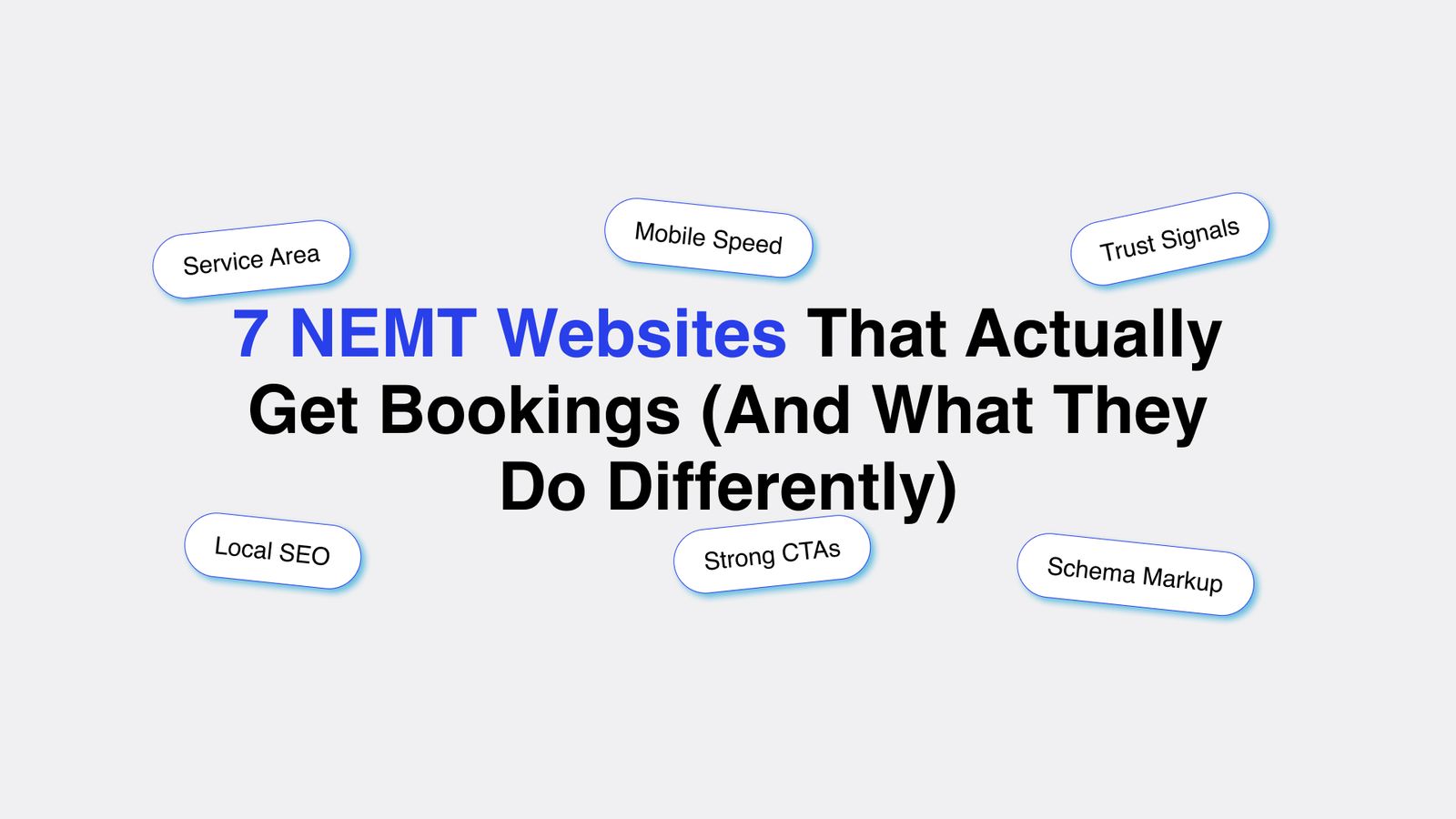
This post breaks down exactly what those sites do differently across 7 areas, so you can apply the same to your own.
This post covers:
- Clear Service Area
- Mobile Speed
- Trust Signals
- Local SEO
- Strong CTAs
- Schema Markup
- Broker Pages
1. Clear Service Area
The number one reason a NEMT website fails to convert is vague location information. A coordinator at a hospital in Fort Lauderdale does not want to read "we serve South Florida." She wants to see Fort Lauderdale listed, along with the surrounding zip codes you cover.
NEMT websites that get bookings have dedicated service area pages. Each page targets a specific city or county. The page names the area in the title, the headings, and the body copy. It lists the types of facilities in that area that the company works with. It includes a local phone number if possible.
This does exactly two things. It tells coordinators and patients that you serve their specific location. And it gives Google a clear signal to rank you for searches in that area.
If your site says "we serve the greater metro area," you are invisible to everyone searching for a specific city. Operators with individual pages for Miami, Hialeah, Coral Gables, and Doral show up in all four markets. Operators with one generic page show up in none.
A practical starting point: build one page per city you actively serve. Keep each page at least 400 words. Include the city name in the H1, one H2, the meta title, and the meta description.
2. Mobile Speed
Over 60 percent of local searches happen on mobile. Patients' families, discharge planners, and coordinators are often searching from their phones. If your site takes more than 3 seconds to load on mobile, a large share of visitors leave before they ever see your phone number.
NEMT websites that get bookings load fast on mobile. That means compressed images, clean code, and a hosting setup that does not slow the site down under normal traffic.
Google also uses mobile page speed as a ranking factor through its Core Web Vitals assessment. A slow site ranks lower in search results, which means fewer visitors reach it in the first place.

Your NEMT Website Should Be Bringing In Bookings
Medflow Digital builds NEMT websites with every element that drives real results. Service area pages, schema markup, broker trust signals, and ongoing SEO, all in one plan.
You can test your current site speed at Google PageSpeed Insights. Enter your URL and look at your mobile score. A score below 70 is a problem. Below 50 is a serious problem. Most NEMT sites built on Wix, GoDaddy, or cheap WordPress themes score in the 30 to 50 range on mobile.
Sites built on Next.js consistently score above 90. That difference in load speed translates directly into more visitors staying on the page and more of those visitors making contact.
3. Trust Signals
A NEMT website that gets bookings answers the broker's or coordinator's core question before they have to ask: can I trust this company with my patients?
Trust signals on a high-performing NEMT site include:
- State operating license number, visible on the homepage or a dedicated compliance page
- Insurance coverage details, including liability limits
- Fleet information, with vehicle types and ADA or wheelchair accessibility details
- Driver credential standards, including background check and CPR certification requirements
- HIPAA compliance statement
- Years in operation and number of completed trips if available
Most NEMT operators skip several of these. They assume coordinators will just call to ask. Coordinators do not call to ask. They move to the next provider whose site already answered the question.
Adding these elements to your site does not require a redesign. A single "Why Choose Us" or "Compliance and Credentials" page with this information does the job. Link to it from your homepage and your service pages.
4. Local SEO Built Into the Site
A NEMT website that gets bookings is not just built to look good. It is built so Google can find it, read it, and rank it for the searches your potential clients are running.
Local SEO built into the site means several specific things.
Your business name, address, and phone number appear in the same format on every page, usually in the footer. This is called NAP consistency, and it is one of the signals Google uses to verify you are a real local business.
Your page titles include location keywords. "NEMT Provider in Dallas, TX" is a page title that can rank. "Home" is not.
Your site has an XML sitemap submitted to Google Search Console. Without this, Google may not find all your pages.
Your images have alt text that describes what is in the image and includes a location or service keyword where natural.
Your internal linking connects your service pages to your location pages and your homepage. Google uses these links to understand the structure of your site and the relationship between pages.
None of this is complicated. All of it is ignored by the majority of NEMT websites currently online.
5. Strong, Visible Calls to Action
A NEMT website that gets bookings makes it easy to take the next step. The phone number is visible at the top of every page. There is a contact form that takes less than 60 seconds to fill out. There is a clear button above the fold that says something direct, like "Request a Ride" or "Contact Us Today."
Weak CTAs are vague. "Learn More" tells a visitor nothing. "Schedule Your Ride" tells them exactly what happens when they click.
The placement matters too. Most visitors do not scroll to the bottom of a page before deciding whether to contact you. Your primary CTA needs to appear in the first screen of content, before any scrolling is required. It should also appear again mid-page and at the bottom for visitors who do read through.
One operator we reviewed had a contact form, but it was buried at the bottom of the About page. Their bounce rate was high and their form submissions were near zero. Moving the form to the homepage and adding a visible phone number to the header produced a measurable increase in contacts within two weeks, with no other changes to the site.
6. Schema Markup
Schema markup is structured data you add to your site's code. It tells search engines exactly what your business is, where it operates, what services it offers, and how to contact you. It also powers the rich results and AI-generated answers that now appear at the top of many search pages.
NEMT websites that get bookings have schema markup correctly installed. At minimum, this includes LocalBusiness schema with your NAP data, service area, and business hours. More complete implementations include Service schema for each service type and FAQ schema for common questions.
Without schema, Google reads your site and makes inferences. With schema, you tell Google directly. That directness improves your chances of appearing in featured snippets, AI Overviews, and voice search results.
It also matters for AI answer engines like ChatGPT and Perplexity, which are increasingly used to find local service providers. These tools pull structured information from sites that make it easy to extract. Sites without schema are harder to cite, which means they appear less often in AI-generated answers.
Most NEMT operators have never heard of schema markup. That means installing it correctly puts you ahead of the large majority of your local competitors immediately.
7. Broker and Facility-Specific Pages
The best-performing NEMT websites go one step beyond general service pages. They have content written specifically for the types of referral sources they want to work with.
A page titled "NEMT Services for Dialysis Centers" speaks directly to the coordinator at a dialysis clinic. It describes how you handle recurring trips, what your scheduling process looks like, and what credentials your drivers carry. It answers the questions that coordinator has before they pick up the phone.
The same logic applies to pages for hospitals, nursing facilities, assisted living communities, and behavioral health centers. Each referral source has specific concerns. A page that addresses those concerns directly converts at a higher rate than a generic services page.
These pages also rank for specific search terms that general competitors are not targeting. "Medical transportation for dialysis patients in Houston" has far less competition than "NEMT provider Houston." A dedicated page targeting the specific term can rank quickly and bring in a consistent stream of relevant traffic.
Most NEMT operators have one services page. Operators with five to ten targeted facility pages have a clear search and conversion advantage.
How Medflow Digital Builds NEMT Websites That Get Bookings
Every element in this post is something Medflow Digital builds into every NEMT website we deliver. We work exclusively with NEMT providers, which means we do not apply a general template and call it done.
Here is what that looks like in practice.
We build on Next.js, which consistently scores above 90 on Google PageSpeed Insights for mobile. That directly addresses the speed problem that holds back most NEMT sites built on Wix or WordPress.
We write and build dedicated service area pages for every city you actively serve. Each page is written with the correct location keywords, structured for local search, and linked properly to the rest of your site.
We install complete schema markup from day one, covering LocalBusiness, Service, and FAQ schema. This gives your site the structured data it needs to appear in AI answer engines and Google's rich results.
We write your trust signals into the site copy. Insurance details, driver credentials, compliance statements, and fleet information are all positioned where brokers and coordinators expect to find them.
We build broker and facility-specific pages if your market calls for it, targeting dialysis centers, hospitals, nursing facilities, or any other referral source you want to reach.
The one-time website build is $799. Ongoing local SEO and Google Business Profile management starts at $499 per month through the Business Starter plan. No long contracts. No generalist agency applying a standard checklist to a business they do not understand.
To see exactly what is included, visit the Medflow Digital pricing page.
To learn more about what we do specifically for NEMT providers, see our NEMT services page.
If you are ready to build a site that actually generates bookings, book a demo and we will walk through your market together.
Related Blogposts
Continue reading more insights from our medical marketing experts.
NEMT Business Growth
For many non-emergency medical transportation companies, brokers are where the business starts. You get credentialed, add your vehicles and drivers to the network, receive trip assignments, complete the rides, submit the required documentation, and get paid according to the contract. That model can provide something every new NEMT operator needs: trip volume. But volume and profitability are not the same thing. As an NEMT company grows, relying heavily on broker-assigned trips can expose weaknesses that were less obvious when the business had one vehicle and needed every trip it could get.
NEMT Business Growth
Learn how to get more Google reviews for your NEMT business with a simple, repeatable process that works for patients, families, and facility coordinators.
NEMT Business Growth
Set up your NEMT Google Business Profile the right way. This post covers every field, from categories to photos to your business description, with exact steps.
NEMT Business Growth
Ready to make a difference? Launching your NEMT business successfully is more than just a venture—it’s a commitment to improving lives. This step-by-step guide will equip you with essential insights and practical strategies to turn your vision into reality.
NEMT Business Growth
Most NEMT websites are losing bookings every single day without the owner knowing it. Slow load speed, no online booking, missing service area pages, zero reviews, and a homepage that says nothing specific are the 5 problems draining thousands in weekly revenue. This post breaks down exactly what each problem costs you and how to fix it.
NEMT Business Growth
Broker trips pay as little as $8 per ride. Private pay clients pay 2x to 4x more, and they are searching for NEMT services on Google right now. This guide covers how to build a website that ranks and converts, use local SEO, run Google Ads, and win direct facility contracts.
Marketing & Design Newsletter
Subscribe to our newsletter and get cutting-edge marketing strategies, design inspiration, and exclusive tips delivered straight to your inbox.