Author

Published
March 29, 2026
Reading time
8 min read
Content
1. A Clear, Keyword-Rich Page Title and Meta Description
2. Dedicated Service Pages (Not Just One Catch-All Page)
3. A Google Business Profile That Matches Your Website
4. Location Pages for Every Area You Serve
5. Fast Load Speed, Especially on Mobile
6. An FAQ Page With Structured Data
7. Clear Calls to Action on Every Page
8. Social Proof Reviews, Testimonials, and Case Studies
9. Content That Answers What NEMT Patients and Facilities Actually Search
10. A Website That Proves You Are a Real, Credible Business
How to Use This Checklist
Blog post categories
Need a Digital Partner?
Access a dedicated team of NEMT designers and developers. We handle your tech, branding, and growth so you can focus on your mission.
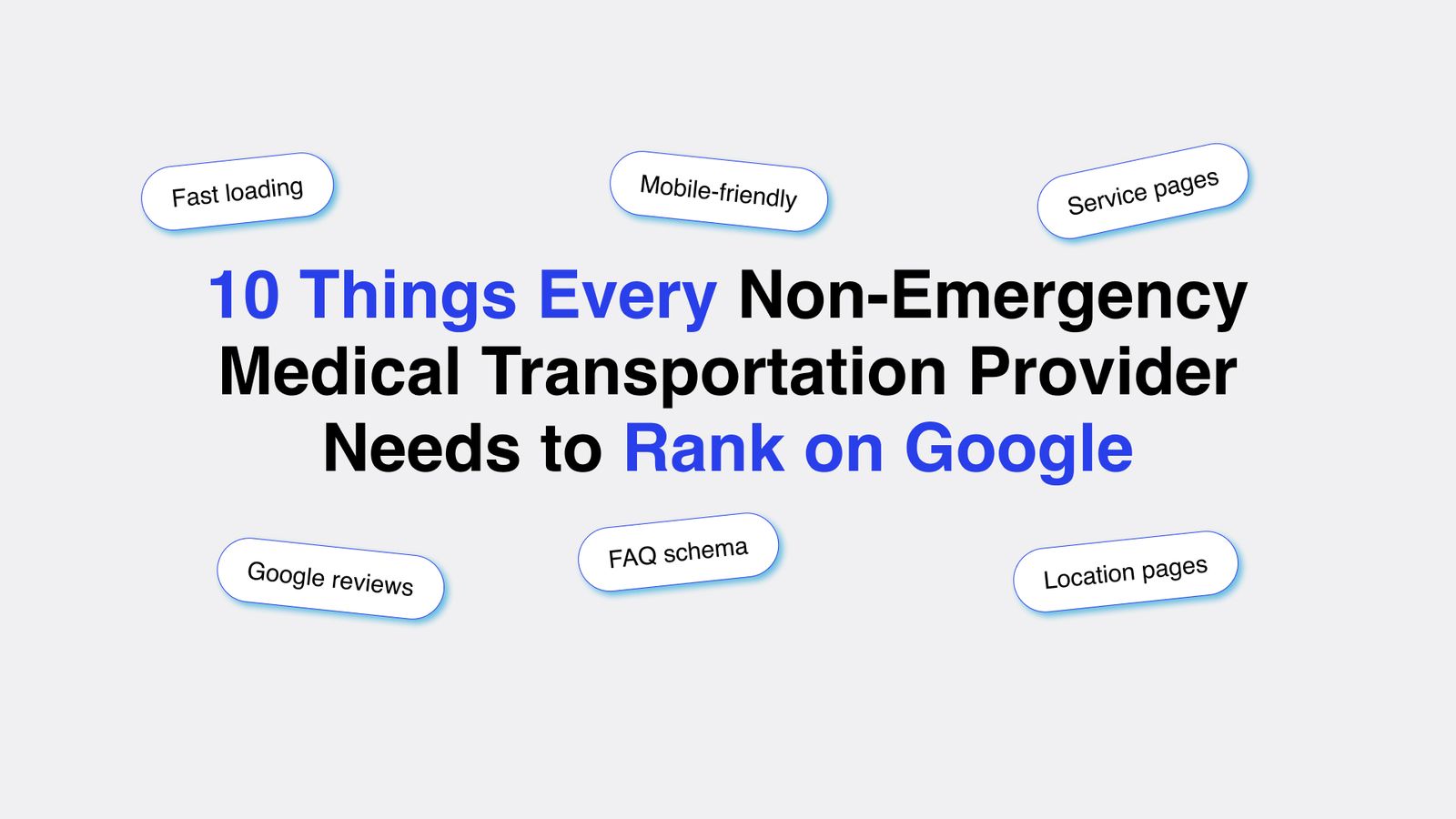
See How It Works10 Things Every Non-Emergency Medical Transportation Provider Needs to Rank on Google
Most NEMT providers who struggle to get clients online have the same problem. It is not that Google hates them. It is that their website gives Google nothing to work with.
No clear service descriptions. No location signals. No structured data. Just a homepage with a phone number and a stock photo of a van.
If you run a Non-Emergency Medical Transportation company and you are not showing up when patients, facilities, or brokers search for you, your website is probably missing one or more of the items on this list. Here are the 10 things every NEMT provider website needs to rank on Google and what to do about each one.
1. A Clear, Keyword-Rich Page Title and Meta Description
This is the first thing Google reads. If your page title says "Welcome to ABC Transport" and nothing else, Google has no idea what you do or who you serve.
Your homepage title should include:
- The phrase "Non-Emergency Medical Transportation" or "NEMT"
- Your city or service area
- A benefit or differentiator if space allows
Example: "Non-Emergency Medical Transportation in Dallas | ABC Medical Transport"
Your meta description should explain what you do, who you serve, and why someone should call you in under 160 characters. Write it like an ad, not a legal disclaimer.
2. Dedicated Service Pages (Not Just One Catch-All Page)
One "Services" page that lists everything you offer does almost nothing for your rankings. Google rewards specificity.
If you offer wheelchair transport, stretcher transport, and hospital discharge rides, each of those should have its own page. Each page should:
- Target a specific keyword (e.g., "wheelchair transportation Dallas")
- Describe the service in plain language
- Explain who it is for
- Include a clear call to action
This is one of the most common NEMT website mistakes we see. A single page trying to cover five services ranks for none of them. See the full list of what every NEMT provider website needs to get bookings to understand how service page structure ties into your overall booking rate.
3. A Google Business Profile That Matches Your Website
Your Google Business Profile and your website need to tell the same story. Same business name, same address, same phone number, same service descriptions. Google cross-references them.
If your GBP says you are located in Plano but your website says Dallas, that inconsistency hurts your local rankings. Google calls this NAP consistency Name, Address, Phone and it matters more than most NEMT operators realize.
Beyond consistency, your GBP needs:
- At least 10 photos (exterior, vehicles, team)
- All services listed individually
- A business description with "NEMT" and your city in the first two sentences
- Weekly posts to signal activity
4. Location Pages for Every Area You Serve
If you serve Dallas, Fort Worth, Plano, and Arlington, you need a page for each city. Not a single "Service Areas" page with a list of cities. Individual pages.
Each location page should be 300 to 500 words minimum and answer the question: why should a patient or facility in that specific city call you? Mention local hospitals, dialysis centers, and medical facilities you serve in that area. This is what makes the page relevant to local searches rather than a duplicate of your main page with a different city name swapped in.
5. Fast Load Speed, Especially on Mobile
More than 70% of local service searches happen on mobile. If your NEMT website takes more than 3 seconds to load on a phone, a significant portion of visitors leave before seeing anything.
Run your site through Google's PageSpeed Insights (free). If your mobile score is below 70, that is a ranking problem, not just a user experience problem. The most common culprits for slow NEMT websites:
- Uncompressed images (a photo of a van at 4MB does nothing for you)
- Cheap hosting that cannot handle even low traffic
- Themes with too many plugins loading in the background
Fix these before doing anything else. Speed is a direct ranking factor.
6. An FAQ Page With Structured Data
Patients and facilities searching for NEMT have specific questions. How do I book a ride? Does my insurance cover this? Do you handle wheelchair patients? Do you work with Medicaid?
An FAQ page answers these questions and gives you a chance to rank in Google's "People Also Ask" boxes, which appear above most regular search results. But the page only works at full strength if you add FAQ schema a piece of structured code that tells Google exactly which questions and answers are on the page.
Without schema, your FAQ page is just a page. With schema, it becomes a candidate for rich results that show up directly in search. Read our full guide on why your NEMT business needs more than a Facebook page for more on why structured, searchable content is what separates visible NEMT providers from invisible ones.
7. Clear Calls to Action on Every Page
Your website exists to get someone to contact you. Every page should make that next step obvious.
That means:
- A phone number in the top right corner of every page, visible without scrolling
- A "Book a Ride" or "Request a Quote" button above the fold
- A contact form that actually works and sends to a real inbox someone checks
We have audited hundreds of NEMT websites where the phone number was buried in the footer, the contact form had not worked in months, and the booking button went to a broken page. Potential clients do not dig. They leave.
8. Social Proof Reviews, Testimonials, and Case Studies
NEMT is a trust business. Patients are getting in your vehicle. Facilities are recommending you to vulnerable patients. Brokers are putting their approval on the line by listing you.
None of them want to be the first.
At minimum, your website needs:
- Google reviews (at least 10, with responses from you)
- 2 to 3 written testimonials from real clients on your homepage or services page
- A case study or before/after story if you have one
If you have zero reviews right now, your first task after reading this is calling every client you have ever served and asking for a Google review. Send them the direct link. Make it a 30-second ask. Getting private pay clients without relying entirely on brokers gets much easier when your social proof is visible and credible.
9. Content That Answers What NEMT Patients and Facilities Actually Search
A blog is not optional for NEMT providers who want long-term organic traffic. Every blog post you publish is a permanent asset that can rank for years.
You do not need to publish every day. You need to publish consistently, targeting questions your patients and clients actually type into Google:
- "How to get Medicaid transportation in Texas"
- "What is NEMT and does my insurance cover it"
- "How to become a preferred NEMT provider with MTM"
Each of these is a question with a real search volume and zero competition from large brands. NEMT is a niche. That means a well-written post from a small regional provider can outrank anybody. Our step-by-step guide to launching a NEMT business shows how content authority builds the same credibility that helps operators win facility contracts.
10. A Website That Proves You Are a Real, Credible Business
This one is less technical but more important than most items on this list. Google's quality guidelines include a concept called E-E-A-T: Experience, Expertise, Authoritativeness, and Trustworthiness. For a local NEMT provider, that means your website needs to prove you are real.
Concretely, that means:
- A real About page with your name, photo, and how long you have been operating
- Business registration information or state licensing if applicable
- A physical address (not just a P.O. box)
- Real photos of your vehicles and team (not stock photos)
- A privacy policy and terms of service page
These signals tell Google and your prospective clients that you are a legitimate operation, not a website someone threw up overnight.
How to Use This Checklist
Go through this list one item at a time. For each item you are missing, treat it as a task with a deadline. Most of these are one-time fixes that pay off for years.
If you want to know exactly where your current website stands, book a free NEMT website audit. We will go through your site item by item and tell you specifically what is costing you visibility and what to fix first.
The NEMT providers who show up on page one are not doing anything complicated. They just made sure their website answered the questions Google was asking. Start there.
Related Blogposts
Continue reading more insights from our medical marketing experts.
NEMT SEO
Affordable SEO for NEMT businesses: what each budget level gets you, red flags to avoid, and how to find a service that produces broker contracts, not just reports.
NEMT SEO
The best SEO tools for NEMT businesses: free tools to start, paid tools worth the cost, platform-specific plugins, and exactly what Medflow uses for NEMT clients.
NEMT SEO
Local SEO for NEMT providers in 2026 covers more than keywords. See what actually works, from Google Business Profile to AI search visibility, with specific steps.
NEMT SEO
Learn how to rank your NEMT business on Google Maps in your city, from profile setup to reviews to local citations, with steps you can start today.
Marketing & Design Newsletter
Subscribe to our newsletter and get cutting-edge marketing strategies, design inspiration, and exclusive tips delivered straight to your inbox.